

Area Pecan Agent
As Area Pecan Agent, I serve Southeast Georgia county agents and pecan growers in site visits, educational programs and research from Augusta to Waycross and Pearson to Fort Valley.
June 15, 2026 - Drone Spraying
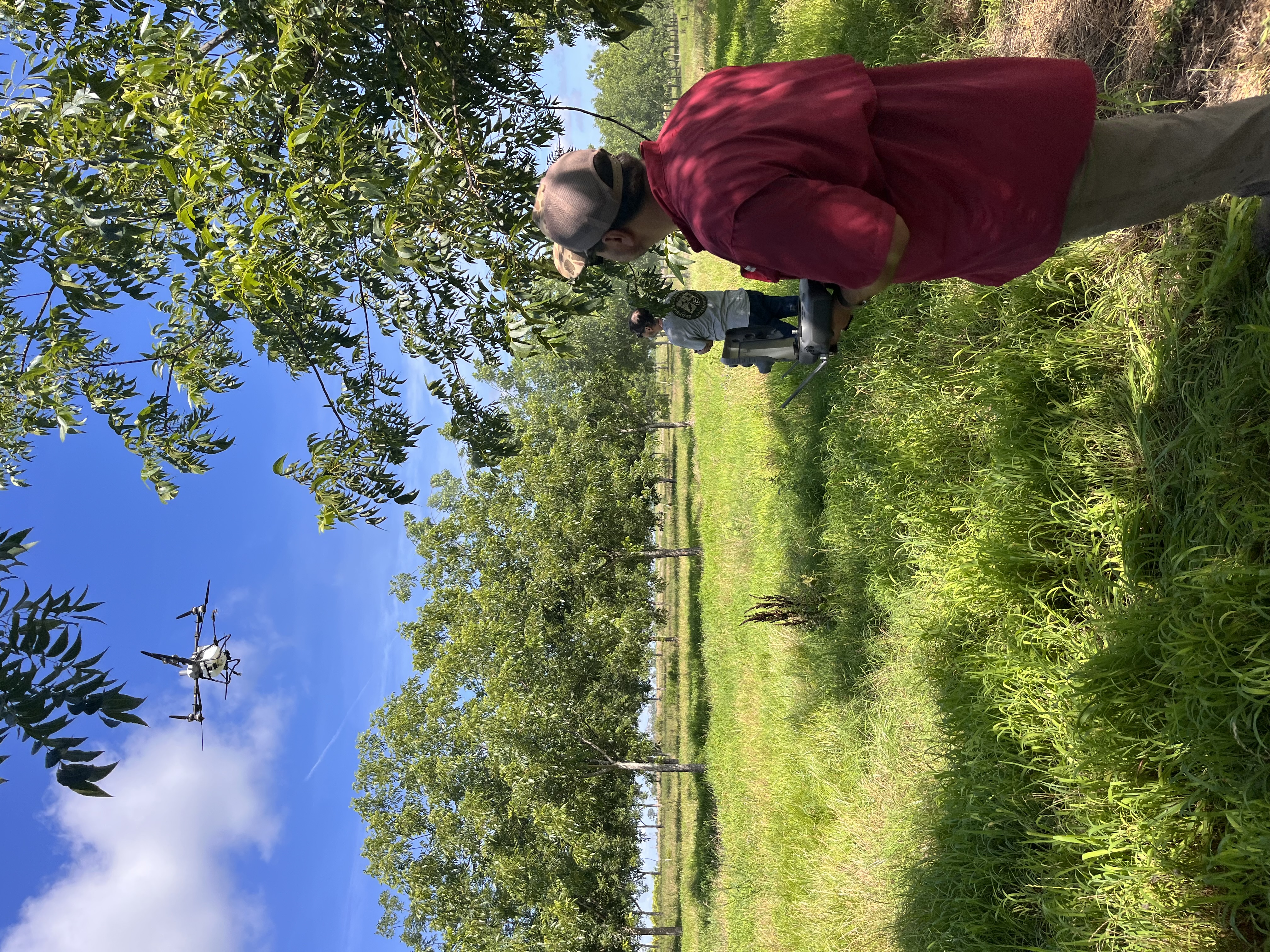
More growers are using drones to apply fungicides. Testing gallons per acre, application coverage and control are ongoing at UGA. Thanks to Dr. Glen Raines, UGA Engineer, for coming to Montgomery County to help a grower conduct basic coverage tests on 25 - foot tall ‘Excel’. The wind was not good to us today.
May 29, 2026 - Alabama Pecan Grower's Association Field Day
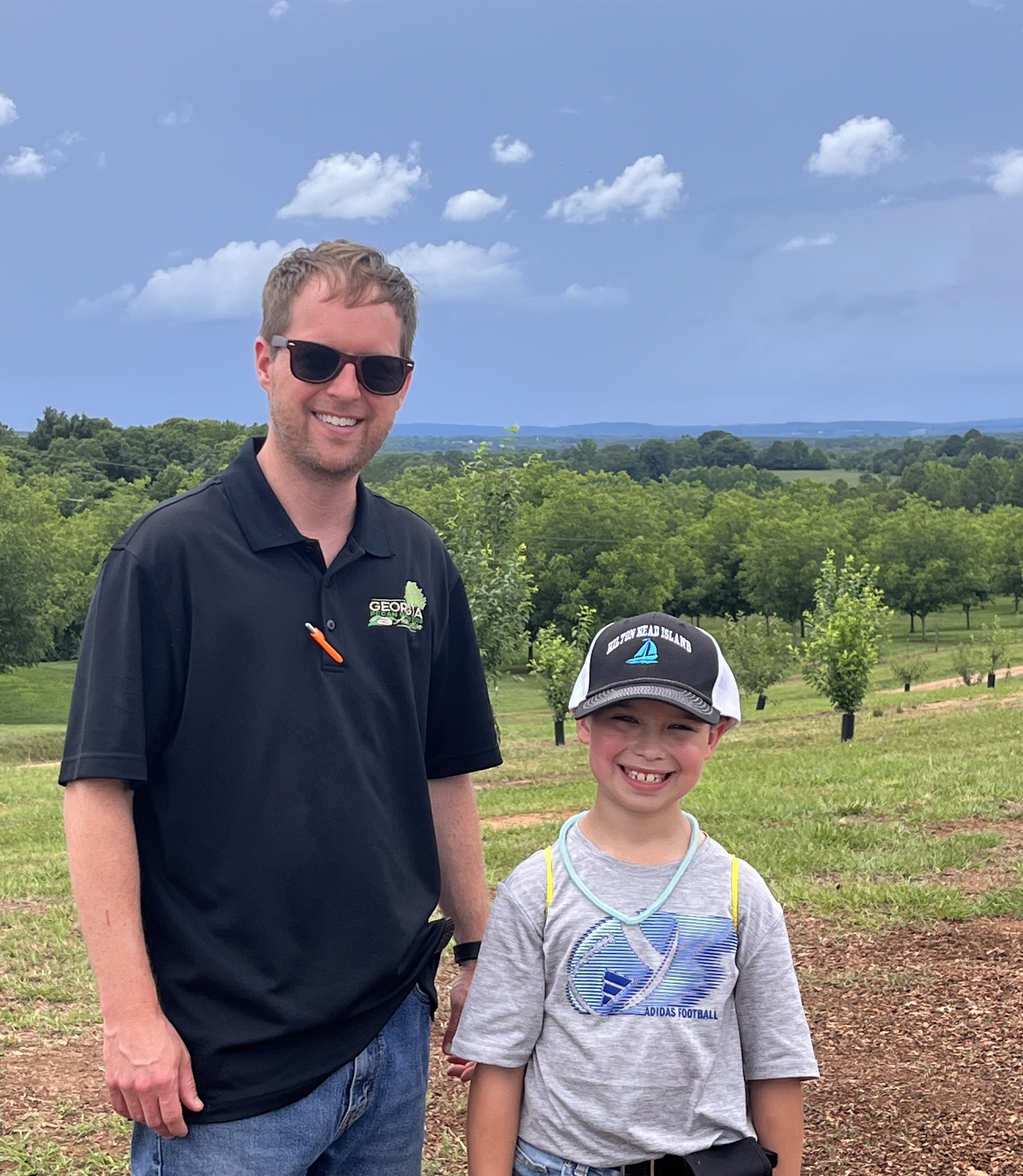
Bryan Wilkins and I were invited to speak at the field day for Alabama in Woodland, AL. The tallest mountain in Alabama is behind us!
April 9, 2026 - In a Nutshell: The Pecan Podcast
The first episode serves as an introduction to the podcast. UGA Extension Horticulturalist Dr. Lenny Wells talks with host, Andrew Sawyer, about the new podcasts, upcoming episodes, the 2025 pecan crop, and finally, a brief synopsis of subjects covered during county production meetings.
In a Nutshell: The Pecan Podcast - Episode 1: Introduction
January 1, 2026 - 4th Year Pre-Emergent Herbicide Data (Auburn & UGA)
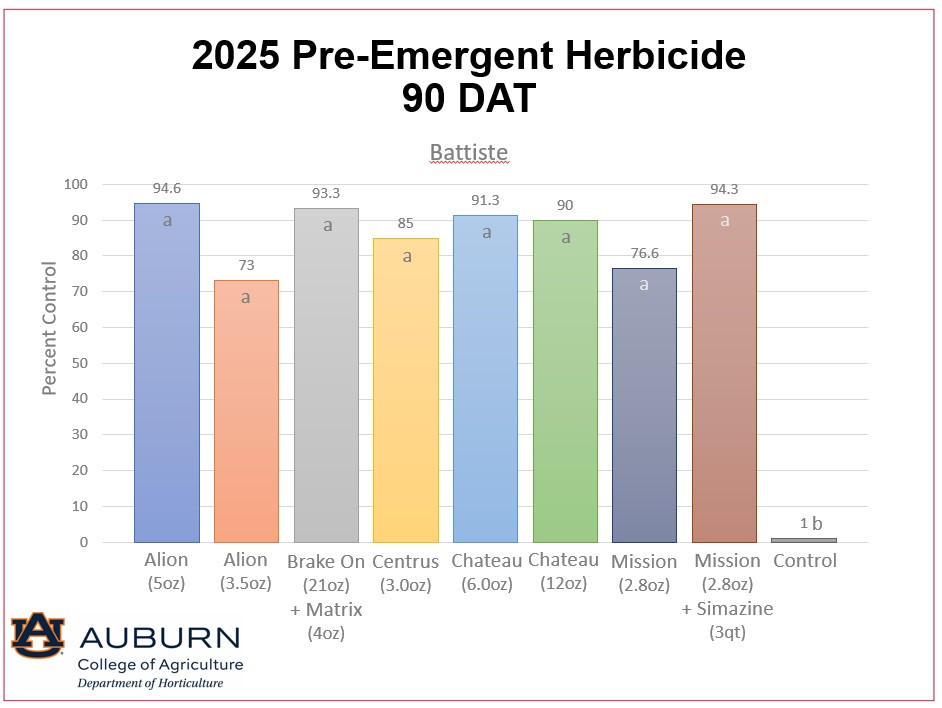
In year four, I just with Mr. Bryan Wilkins of the Auburn Horticulture Department for a collaboration. In previous years, I have compared a full rate of Alion (5 oz / acre) to a half rate (3.5 oz / acre) on virgin soil. Even at half rate, I have observed no significant difference. We are also doing the same thing with Chateau. In 2024 the 6 oz / acre rate of Chateau and full season rate of 12 oz / acre were not statistically different. In 2025, both Mr. Wilkins’s and my Chateau numbers may be statistically different if we had one more replication.
*This was the first year we used Mission. I received a recommendation of rate and combination from weed scientist at NC State. Keep in mind an herbicide will behave different in different soils. But since our numbers were much different and since it is already researched at NC State, I hope to look at this again this year.
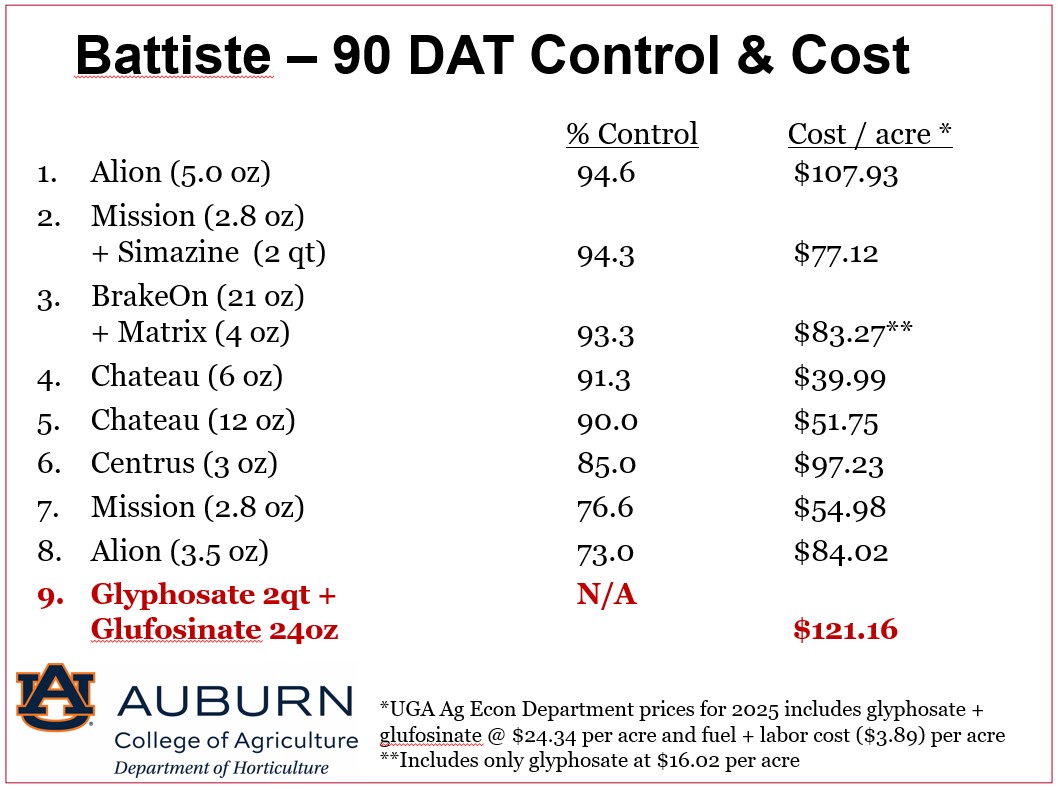
Thanks also to Guy Hancock of the UGA Department of Economics to derive these cost numbers. These are 2025 prices, and herbicide prices have already increased for 2026 unfortunately.
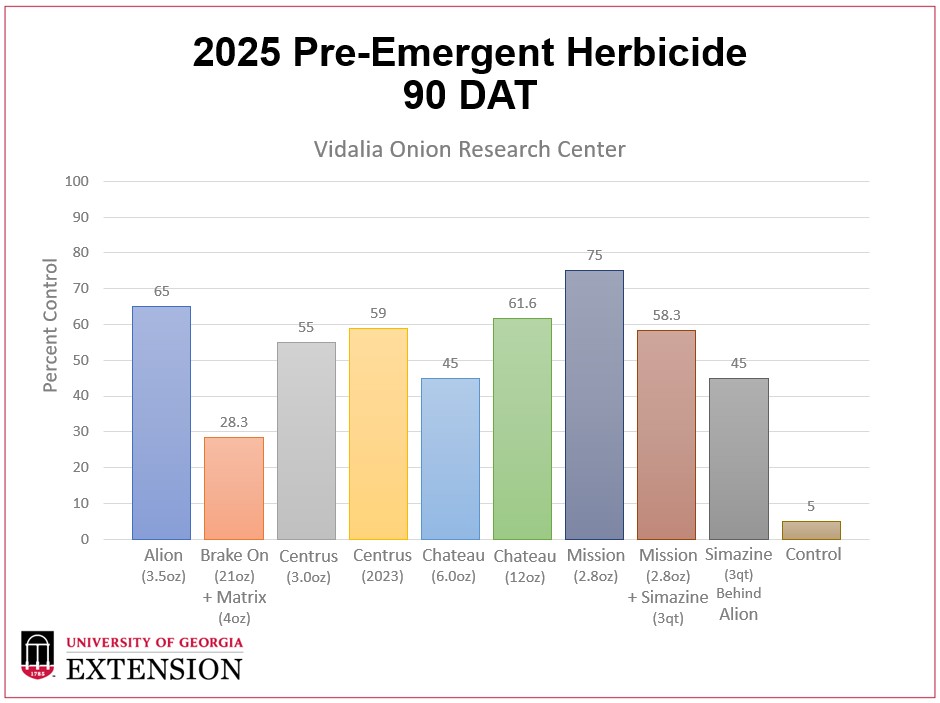
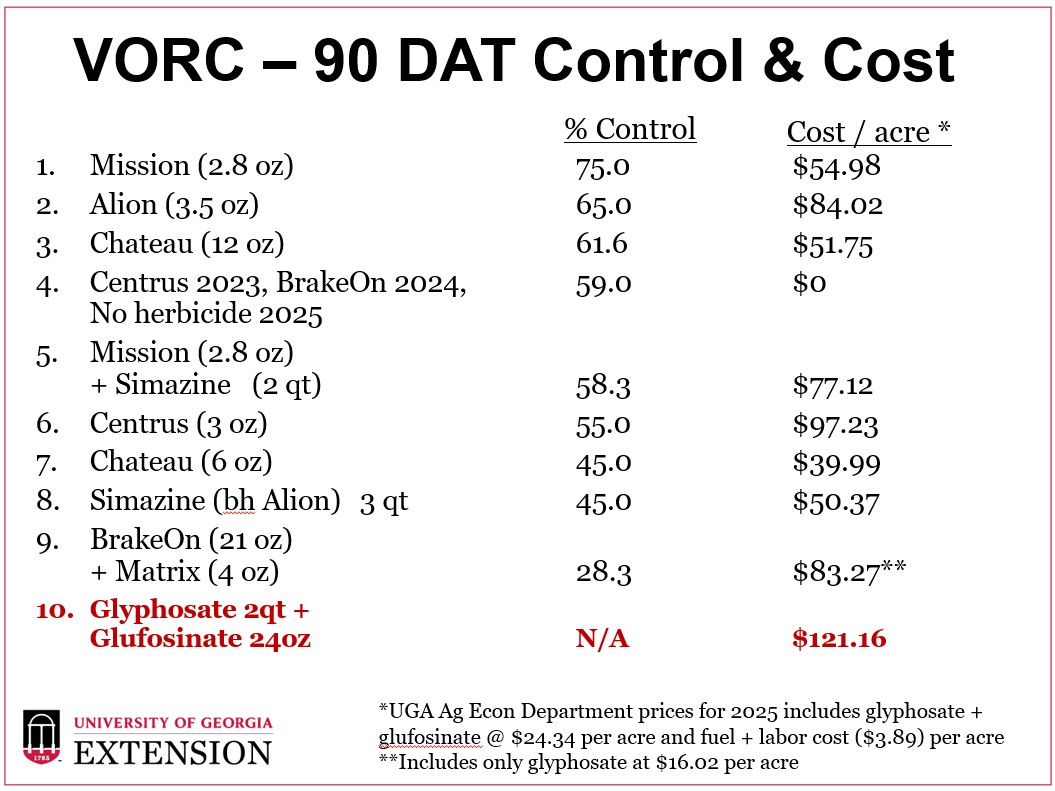
Mr. Wilkins actually conducted the same trial at the Gulf Coast Research Center in Fairhope, AL in addition to the data you see from the Battiste Farms. I'm going to show you the Battiste Farms only since we have a major difference at Battiste. Those pecans are large, old and shaded trees. Look at the difference in control - and ultimately cost savings - once your trees start to shade.
November 20, 2025 - Pecan Harvest Update on Farm Monitor
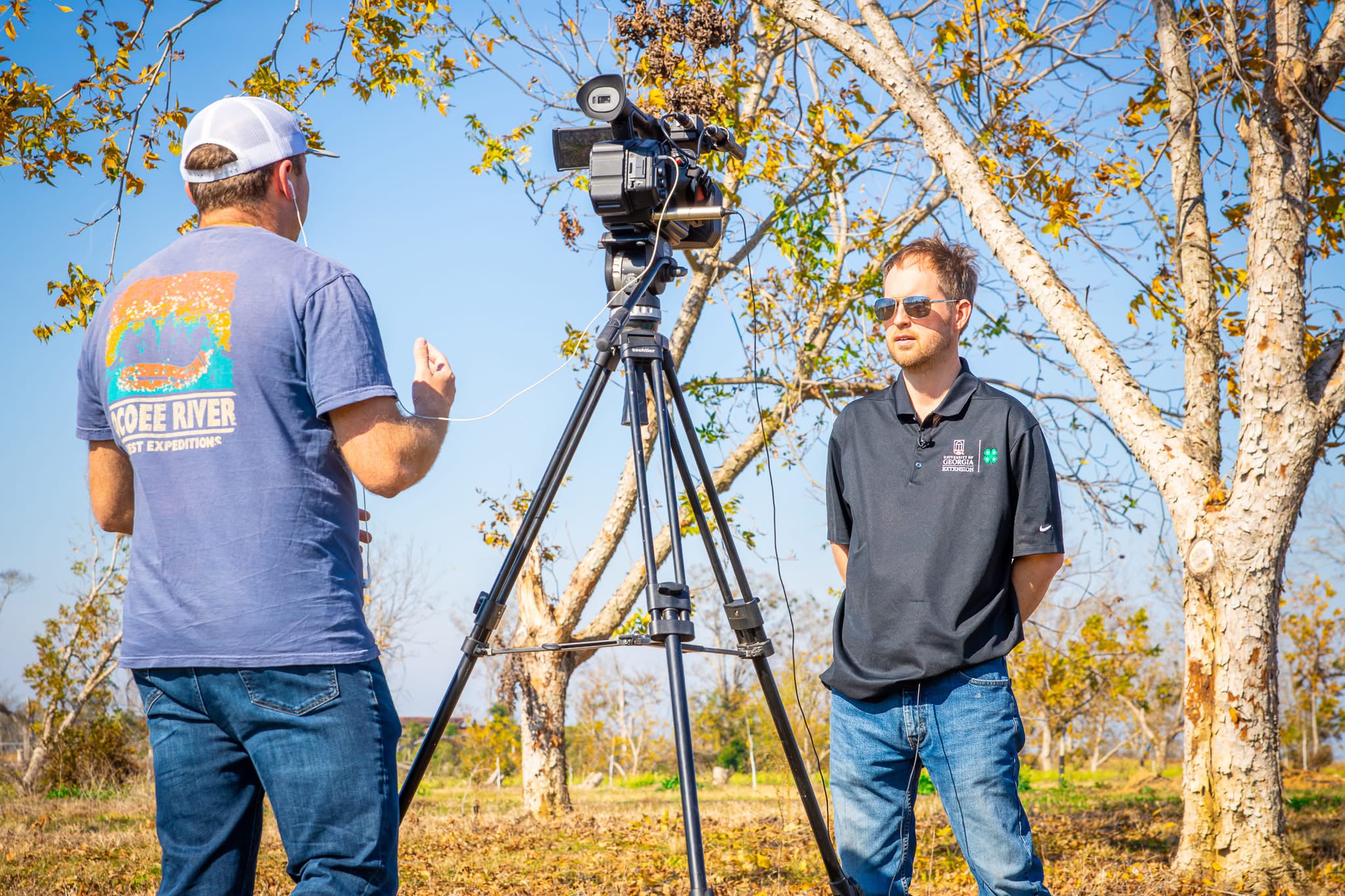
On Farm Monitor once again. The gentleman interviewing me is John Holcomb of Farm Bureau and a wonderful person to ever work with. Thank you John!
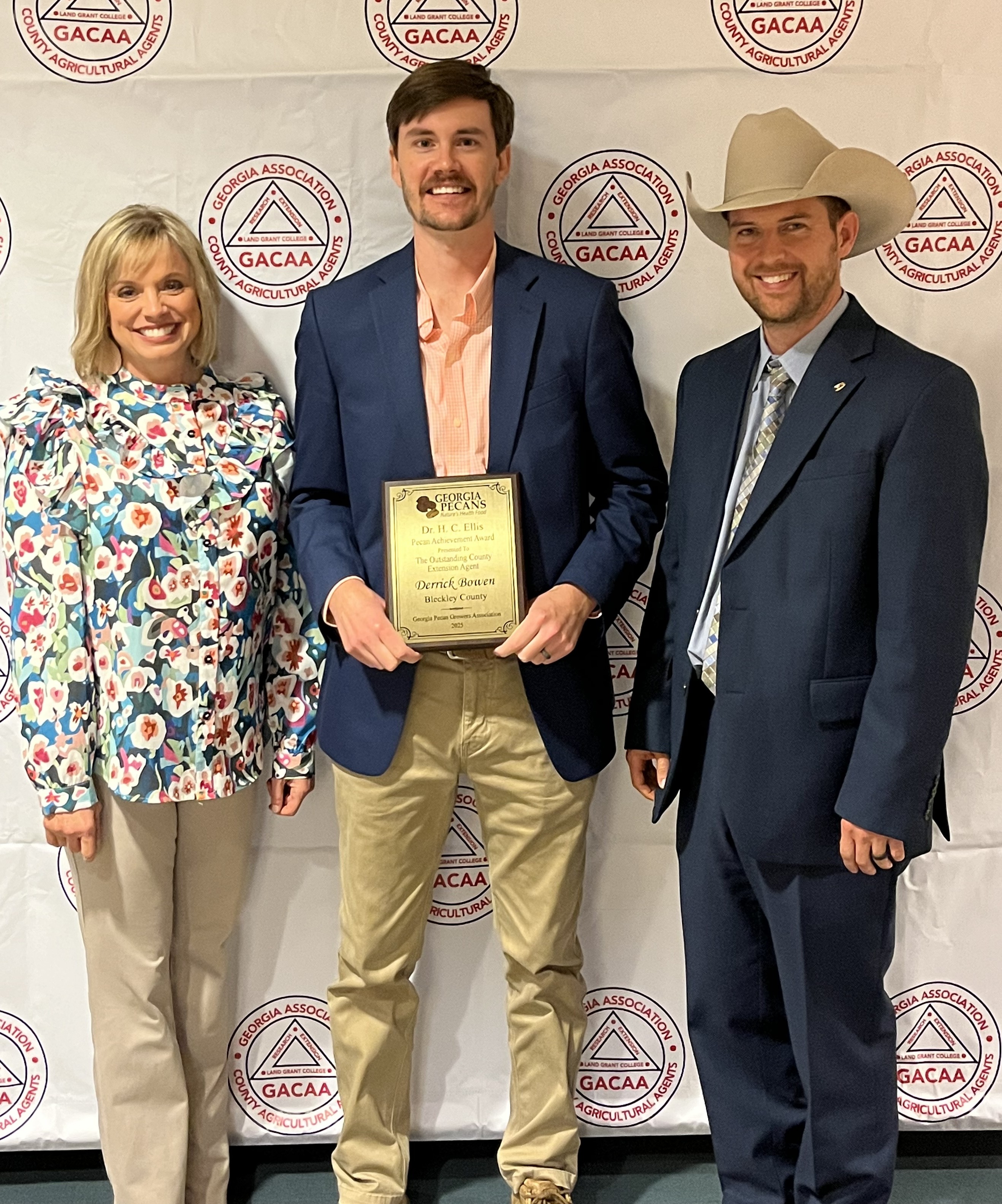
November 12, 2025 - H.G. Ellis Pecan Achievement Award
Congratulations to Derrick Bowen of Bleckley County for the 2026 Pecan Achievement Award sponsored by the Georgia Pecan Grower's Association. Amy Howell of GPGA visited with us in Columbus to present the award.
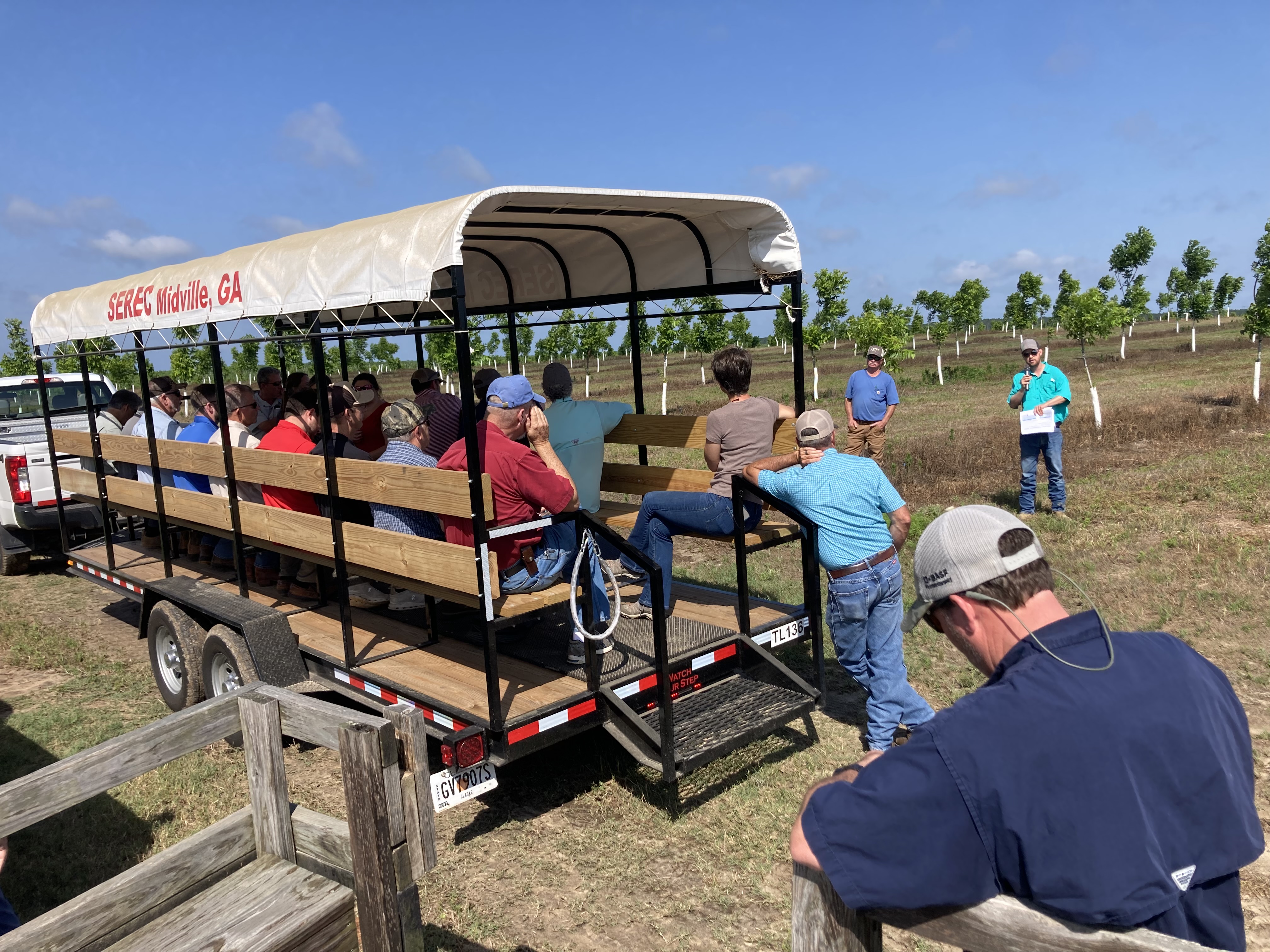
August 27, 2025 - Southeast Pecan Field Day
This year's field day was held in Tattnall County at Mr. John Shuman's orchard managed by Mr. Curt Freeman. A big thanks to Mr. Freeman, Mr. Bert Oliver, county agents Jonathan Smith and Aubrey Shirley for helping execute the field day. 220 pecan growers and industry attended this year. We visited one of the new on-farm scab fungicide sites, an orchard of ‘Treadwell’ variety and pre-emergent herbicides. Thanks to speakers: Dr. Apurba Barman, Dr. Tim Brenneman, Dr. Clemen Oliviera, Dr. Patrick Conner, and Dr. Luan Oliviera and Mr. Bryan Wilkins of Auburn.
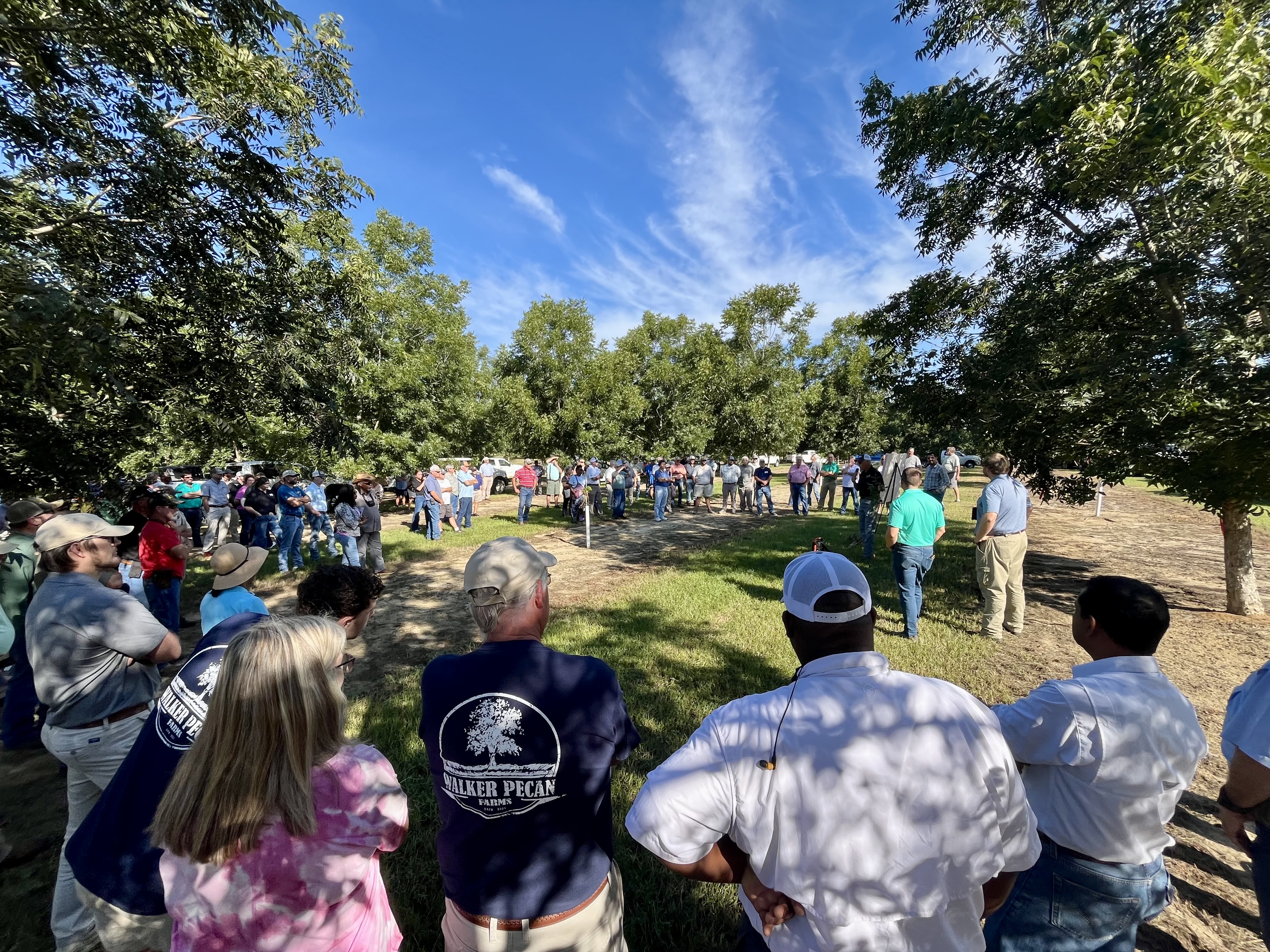
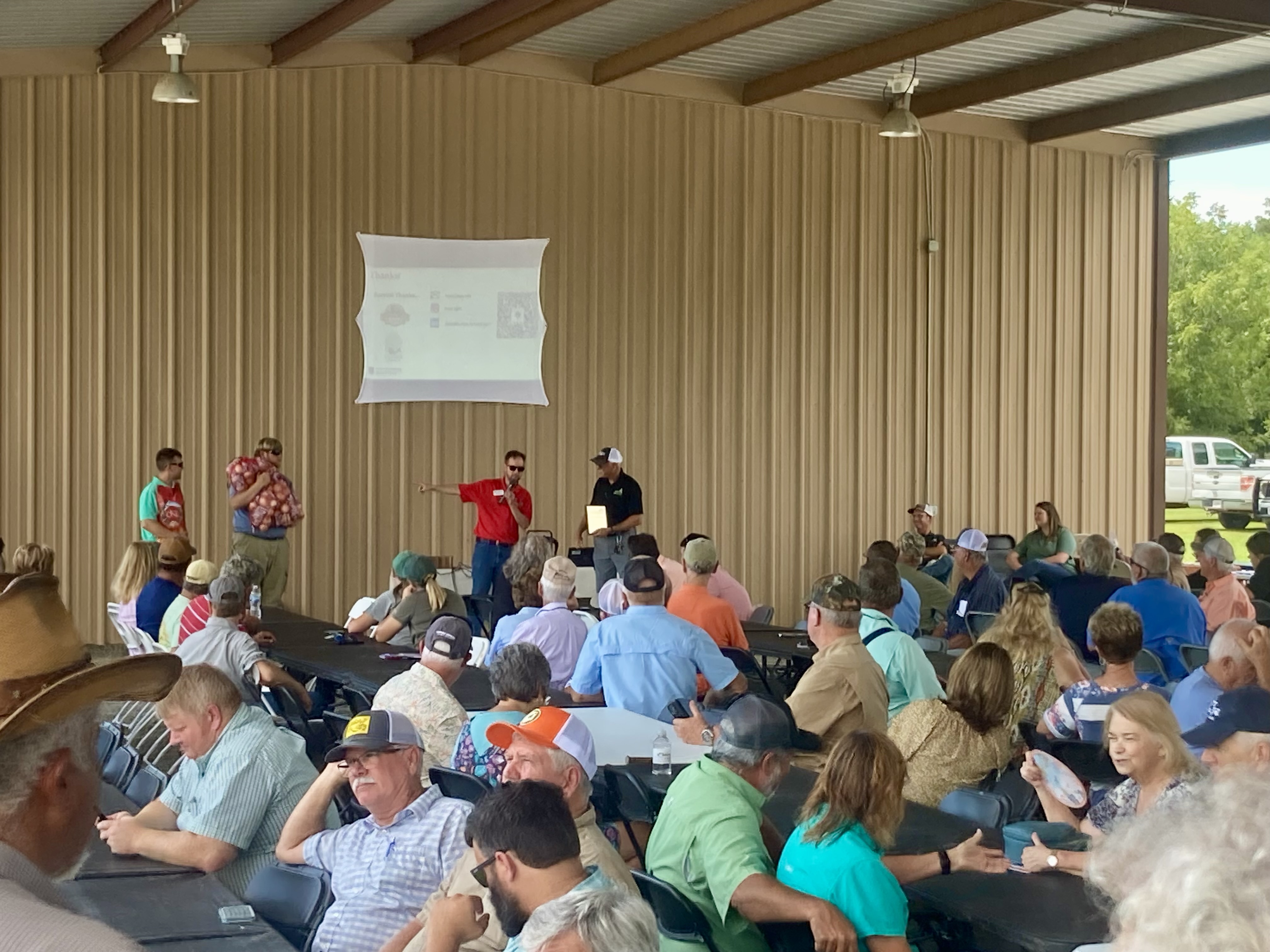
May 21, 2025 - East Georgia Pecan Field Day
Our 5th Annual East GA Pecan Field Day was held in Keysville, GA, Burke County, at Jesse Bentley's new orchard operated by Judson Brannen, Wayne, Mike and Alan Hendrix. They have ‘Avalon', ‘Creek’, ‘Oconee’ with a 35 x 35 spacing for hedging. About 40 growers attended which we concluded with lunch.
January 1, 2025 - 2nd Year Pre-Emergent Herbicide Data from VOVRC
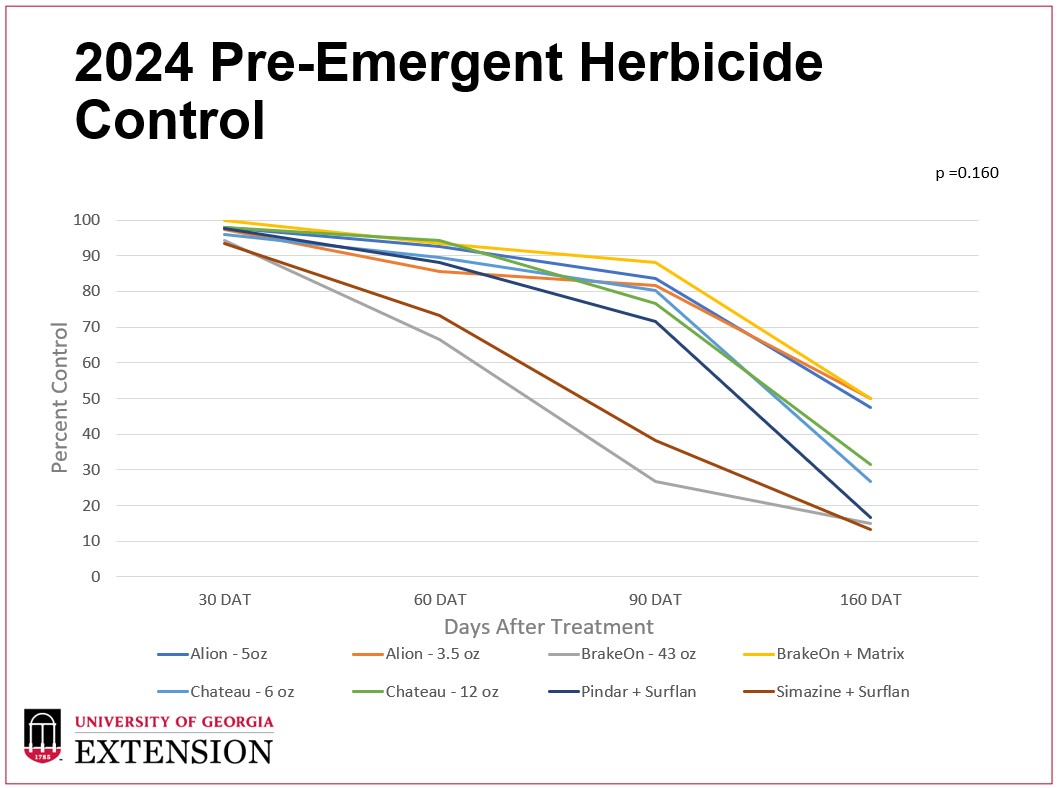
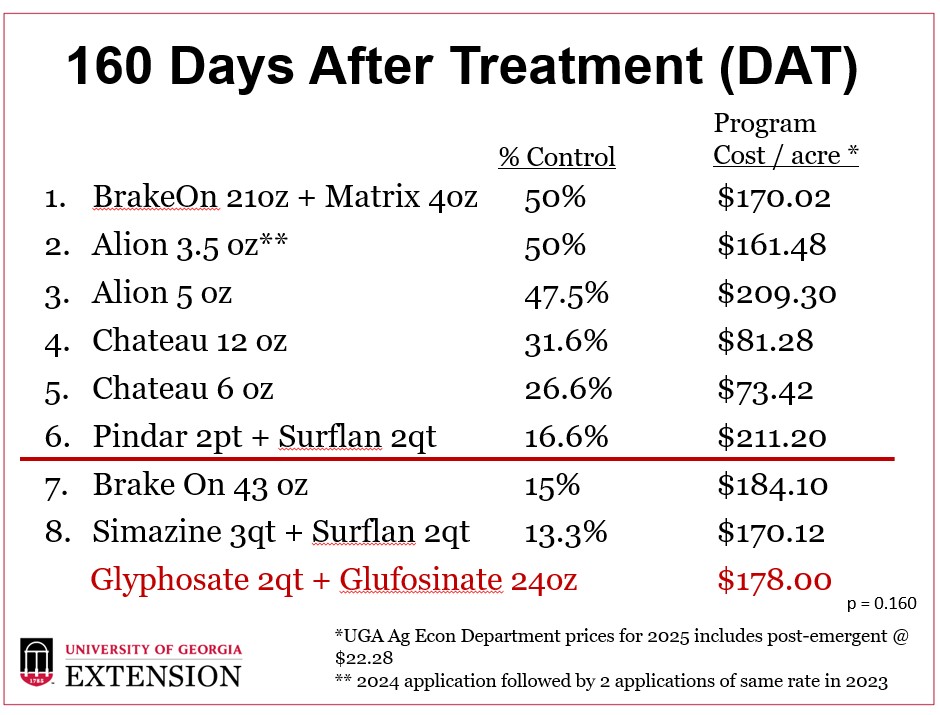
Here is my second full year of pre-emergent work at the Vidalia Onion & Vegetable Research Center on pecans. I once again focused on the full and half rate of Alion on virgin soil, which statistically is not different. This is new for us as we always recommend the full rate (5 oz per acre) applied before dropping to the half rate. With the half rate doing well, this may cut our costs.
Another unique treatment was the same applied to Chateau with half rate compared to full season rate. We never use the full season rate of Chateau, but with sandy soils, we will not hurt pecan. It turns out that the longer we rated effectiveness, the less those rates separated. Growers are better to use two shots of 6 oz / acre compared to a full rate.
And finally, I had the privileged of working with Guy Hancock with the UGA Department of Economics on calculating the cost per acre of each spray, which includes fuel and labor. We include the fuel/labor when applying numerous sprays of post-emergent herbicide. This shows the cost savings in utilizing pre-emergent herbicides.
January 1, 2024 - 1st Year Pre - Emergent Herbicide Data from VOVRC
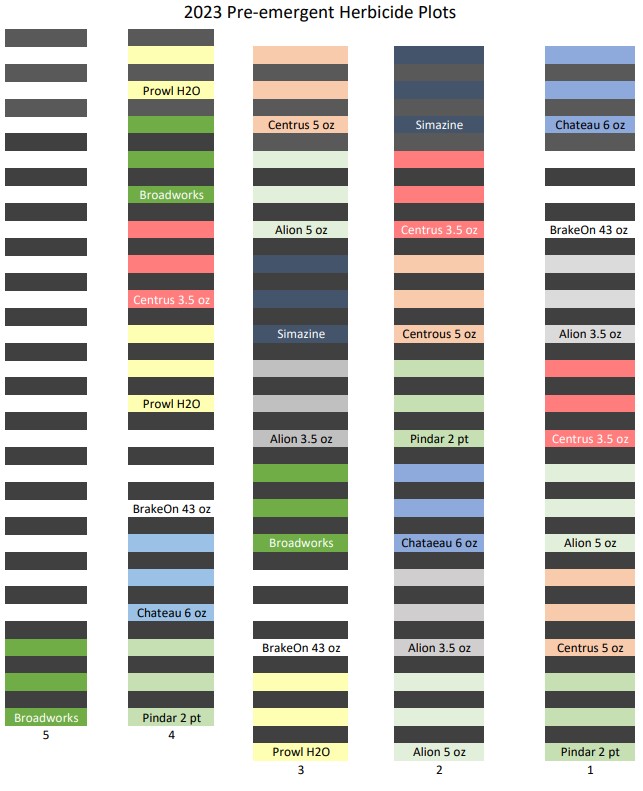
We have the 2023 data on the pre-emergent herbicides at the Vidalia Onion Research Farm. This is every pre-emergent applied on April 5, 2023. We had good rain the day after. All herbicides were applied to bareground soil at 13.5 gallons of water per acre. All herbicides, except Broadworks, did great through 60 days after treatment.
The take-away message here is Alion and Centrus (both indaziflam) having same effect at both full and half rates - on virgin soil. Generally we lower their rate after two applications of 5oz/acre each. Even in full sun on Tifton-loam soil did these half rates hold out.
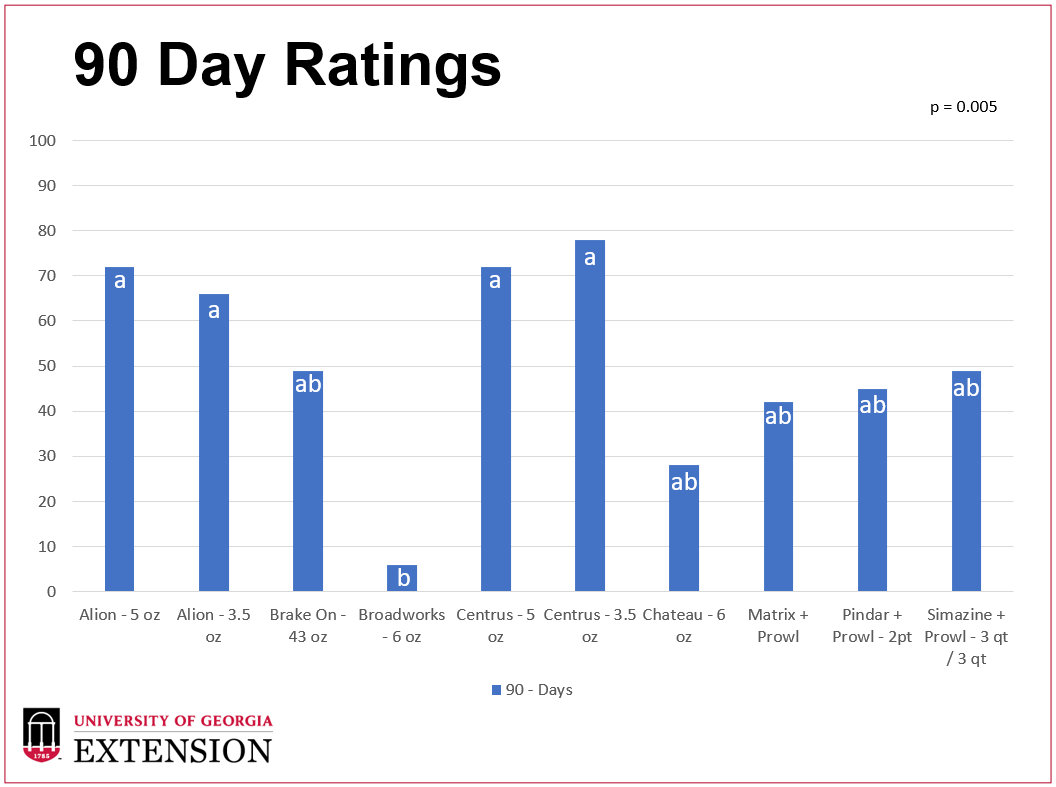
I want to show you one more thing. Pindar GT is an emulsifiable concentrate also that is used off-season (Nov - March). You use 2 pint / acre alone in the fall. In the Spring, Dr. Wayne Mitchem of NC State told me that it needs a tank-mix partner for summer annuals. In the chart above, you will see I mixed with Prowl and its performance was no different than Simazine and Matrix. This chart DOES NOT include Pindar performance from November to April, which I found to be excellent. The research farm has Itallian ryegrass and Raddish. I was mostly impressed by how long it performed - all the way until I sprayed my Spring applications.
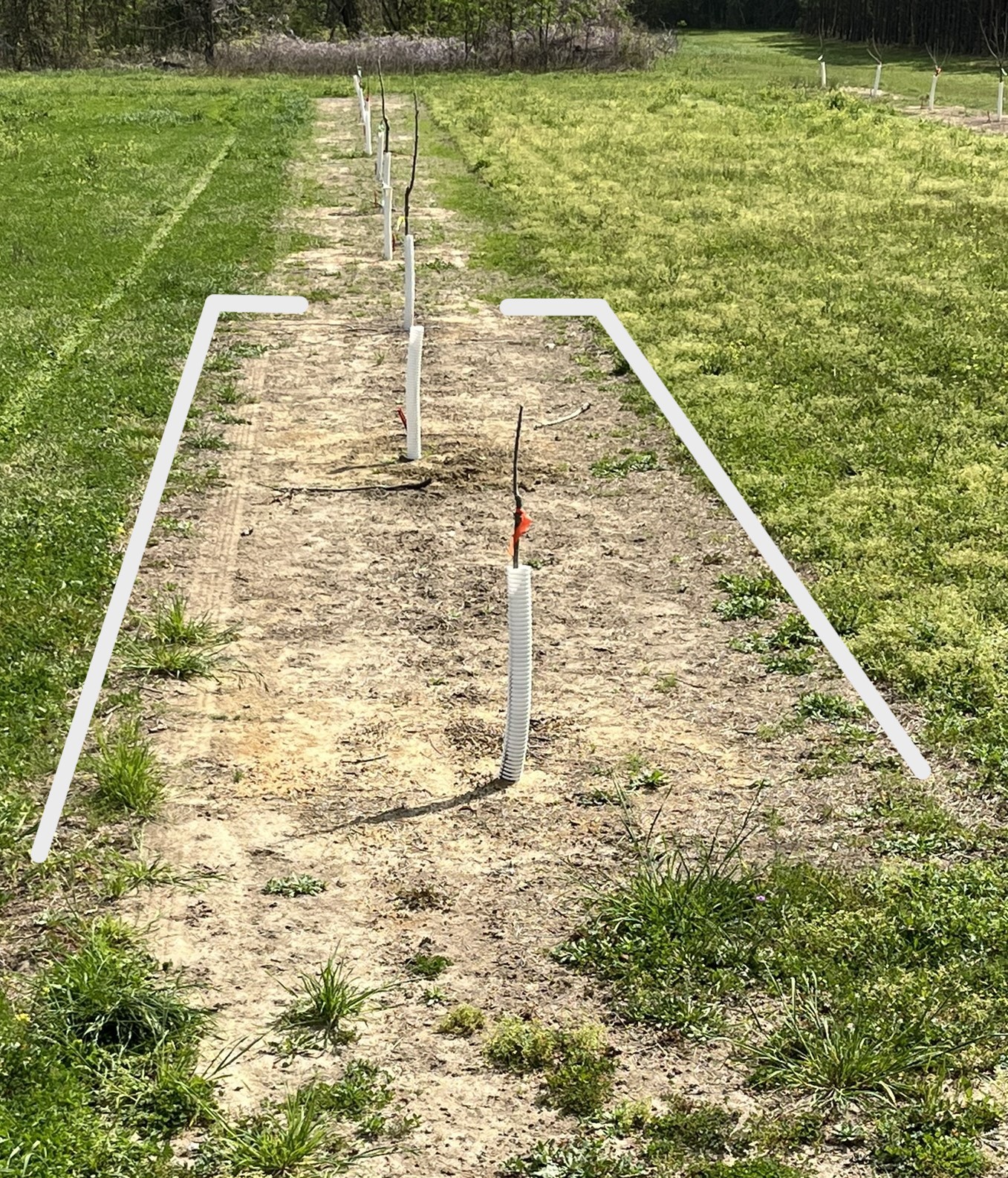
Pindar GT at 120 days after application. 2 pint / acre rate.
April 5, 2023 - Pre - Emergent Herbicides at VOVRC
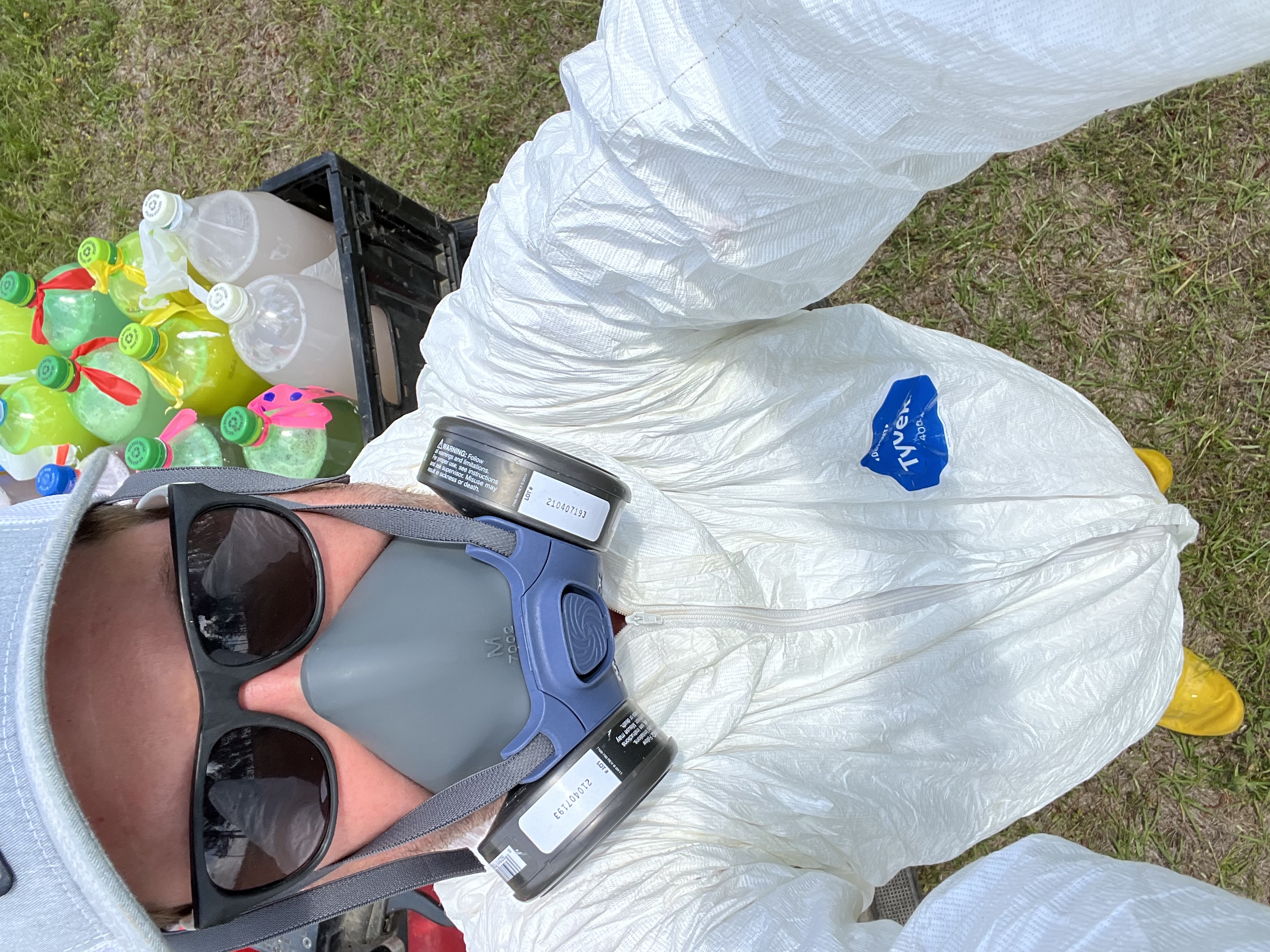
On two very hot days, I wore this COVID-hazmat suit with a CO2 sprayer on my back set at 20psi, walking at 3.1mph applying 13.5 gallons of water per acre to apply 10 different pre-emergent herbicides, three replications each in a randomized plot design at UGA's Vidalia Onion & Vegetable Research Center. Due to the increase in price of glyphosate and glusosinate, these easy-to-use, post-emergent herbicides now cost more money per acre than pre-emergent herbicides. In pecan, we are fortunate to have many herbicides with different modes of action. I am using our most common pre's and also looking at two newly labeled herbicides along with less popular but effective herbicides. We will have a field day later this year for growers to observe for themselves which ones they like.
These herbicides were mixed with 2 qts glyphosate + 24 oz glufosinate per acre.
Product Rate/Acre
Alion 5 oz
Alion 3.5 oz
Broadworks 6 oz
Brake On 43 oz
Centrus 5 oz
Centrus 3.5 oz
Chataeau 6 oz
Matrix + Prowl 4 oz / 3 qt
Pindar 2 pt / 3 qt
Simazine + Prowl 3 qt / 3 qt
February 2, 2023 - Pecan Planting Homecoming
Behind the Coffee High Marching Band field, which I was member from 2000 - 2003, new pecan trees were planted. Coffee County Young Farmer's Teacher, Spencer Highsmith, organized the planting of new low-input pecan varieties and coordinated a pecan planting clinic taught by Andrew. Coffee High students helped plant trees followed by this crew below, which turned into a homecoming for me and my 4-H Agent, Kevin Tatum. The practice field is in the background with the tower in the middle. Mr. Kevin and I played in the Coffee High Marching Band and also the UGA Redcoat Band.

From L - R: Andrew Sawyer, Kevin Tatum (Former Coffee Co 4-H Agent), Ashley Smith (Coffee Co ANR Agent), Spencer Highsmith (Coffee Co Young Farmer's Teacher) and Madison Britt (Coffee Co 4-H Agent).
March 28, 2022 - Phosphite on Non-Bearing Pecan Trees
In 2020, I started a new research treating non-bearing trees with phosphite to see if there are growth benefits and justification for scab sprays for young pecan. Phosphite is a reduced form of phosphate. Plants get phosphorus from phosphate. Phosphites have fungicide properties and are great at controlling leaf scab. Interestingly there is much research on phosphite interactions in crops showing yield increase since the 1980s. There is also significant research showing phosphite interactions with phosphorus damaging to the plants, interfering with P uptake and also proof that plants lack the enzyme to oxidize phosphite to phosphate inside the plant, making phosphite useless as a nutrient. None of this work was done on pecan. We use phosphites for leaf scab control of mature pecan. We are planting lots of pecan in Georgia, and growers are experimenting with different managements.
Treatments replicated four times:
1. Two quarts phosphite / acre, every 3 weeks
2. Two quarts phosphite / acre, every 6 weeks
3. Four quarts phosphite / acre, every 3 weeks
4. Four quarts phosphite / acre, every 6 weeks
5. Control
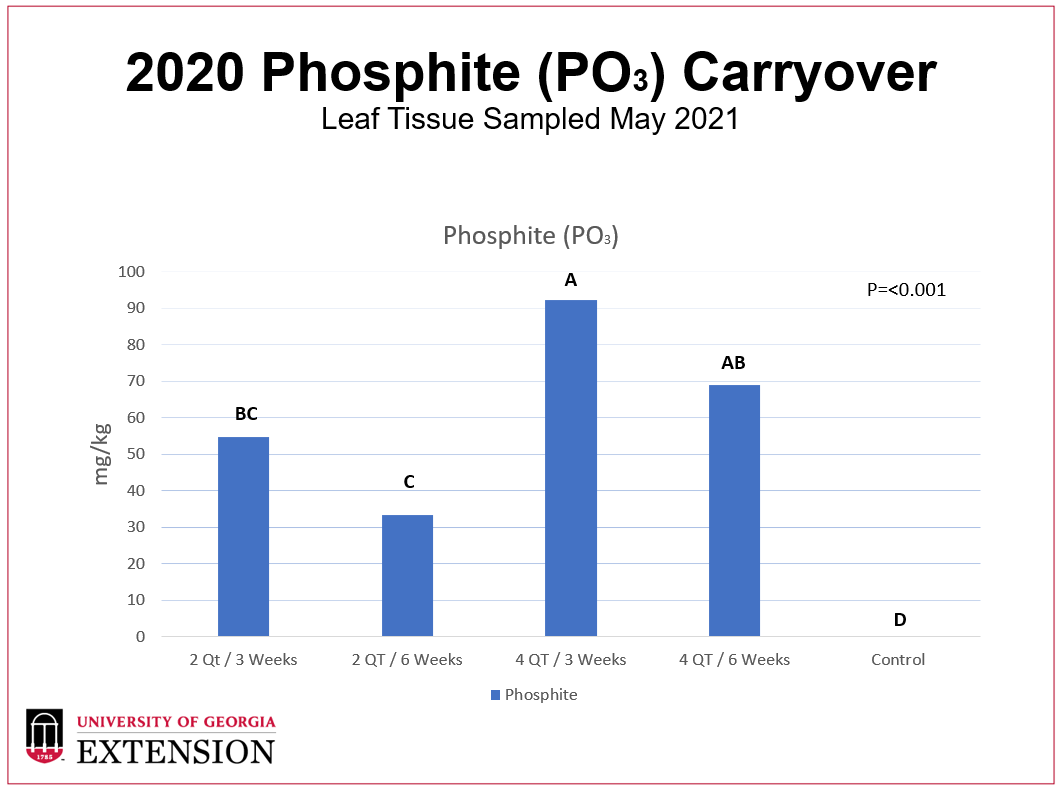
After the first season of treatments, K-Phite paid for these particular leaf samples that we took in May of 2021. This represents the phosphite carryover in the trees from 2020 and provides significant information. What the above graph shows is that every treatment carried over phosphite. This means in addition to translocation, phosphite staying in the trees.
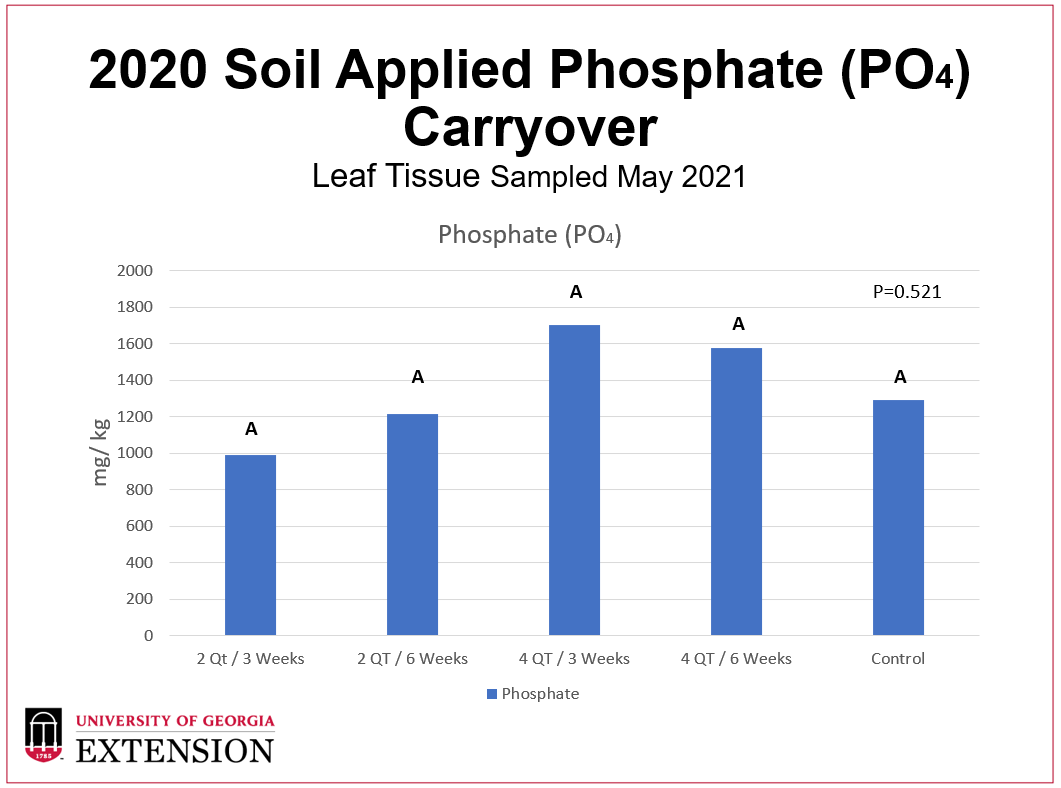
This table is even more significant. The lab we sent these samples to in California is able to separate the phosphite from the phosphate. The phosphate is being taken up by the trees from soil application. Remember the work that shows where phosphite interferes with uptake of phosphate? This data proves that not to be the case in 2-year-old pecan. Though the bars are different heights, he letter A signifies this is not different. This is good news if spraying young trees becomes a norm.
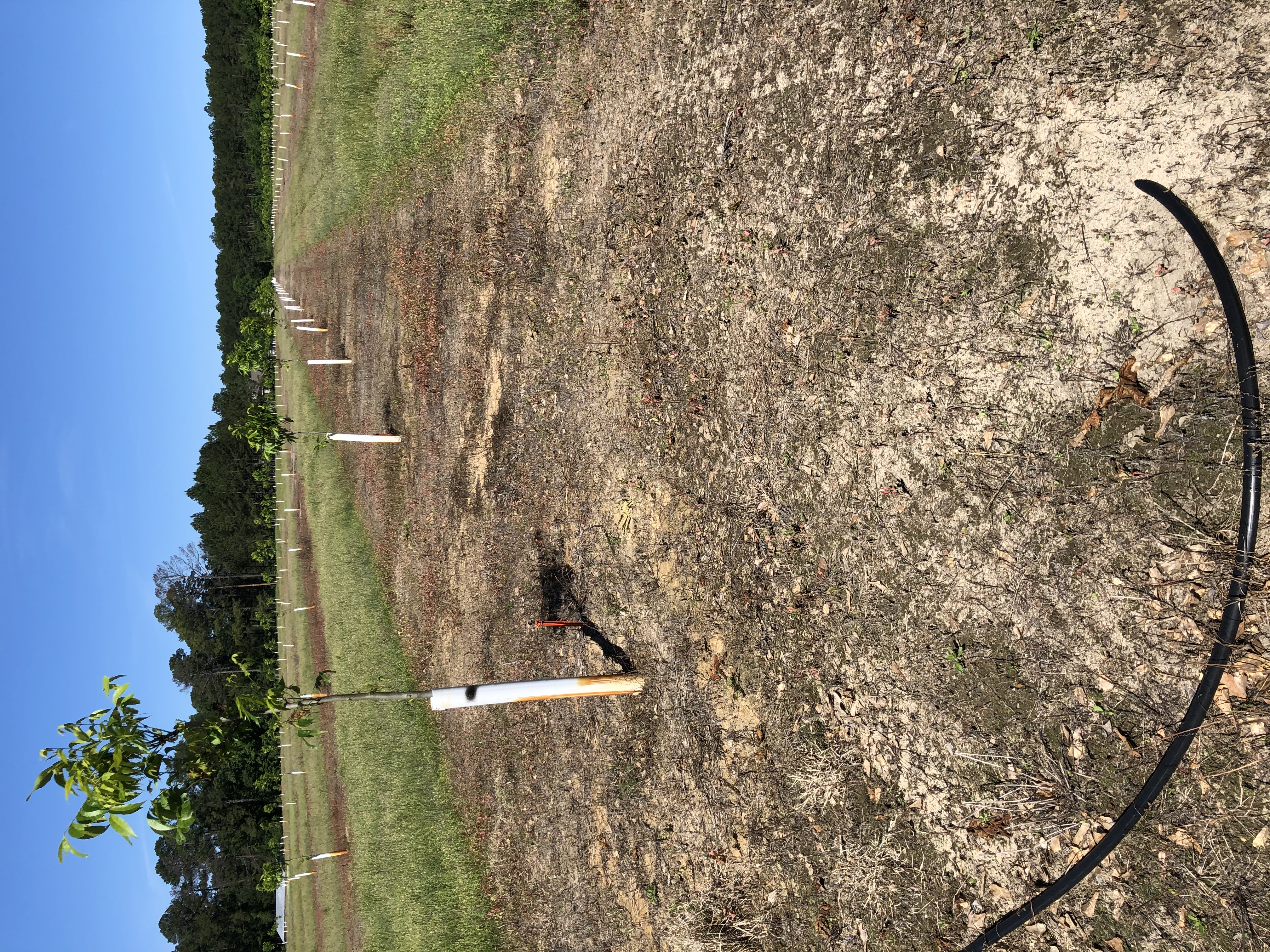
This photo was taken in 2020, the first year of the study. These are two-year ‘Caddo’ in Laurens County, GA.
January 10, 2021 - Ambrosia Beetle Research
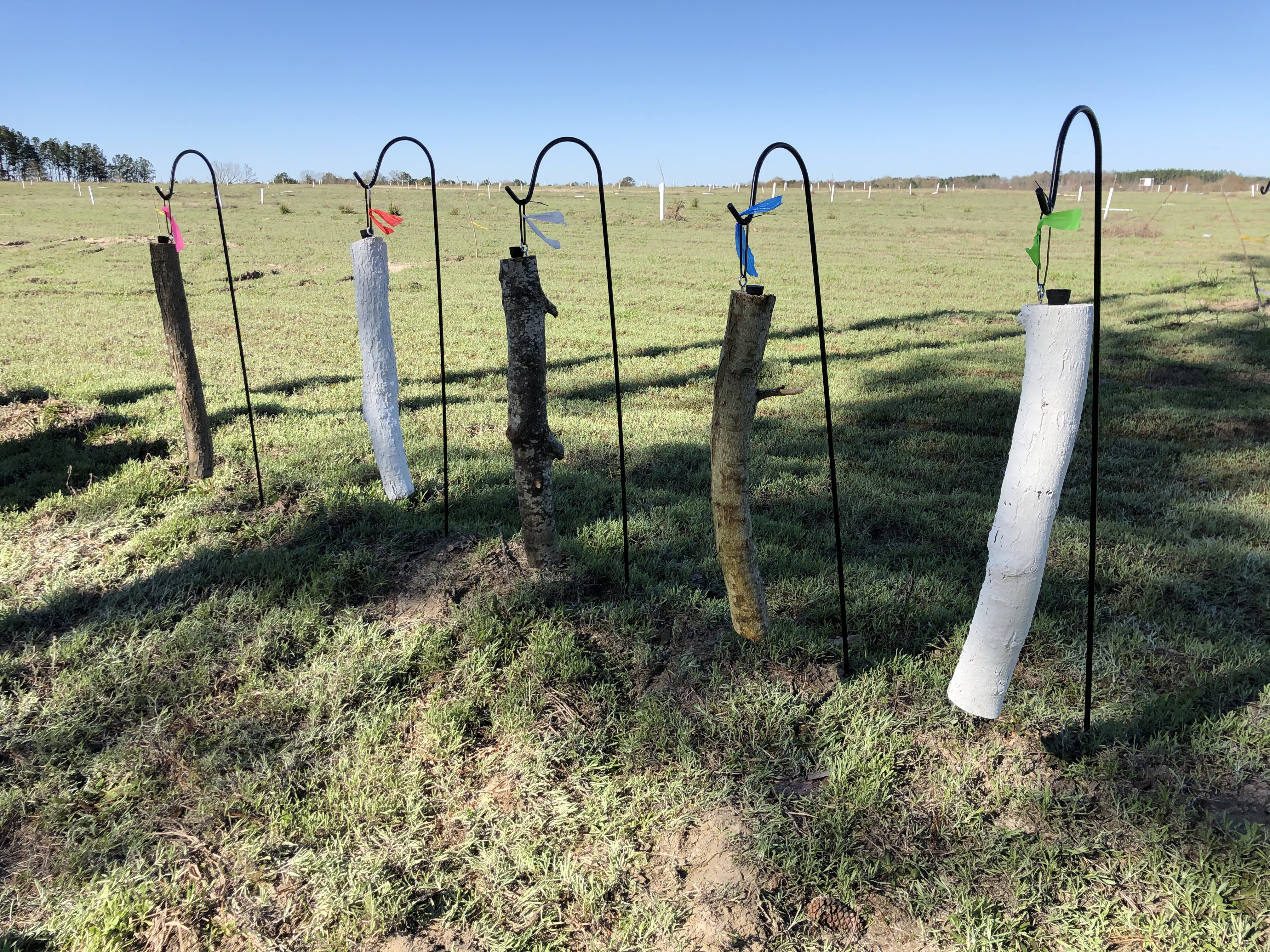
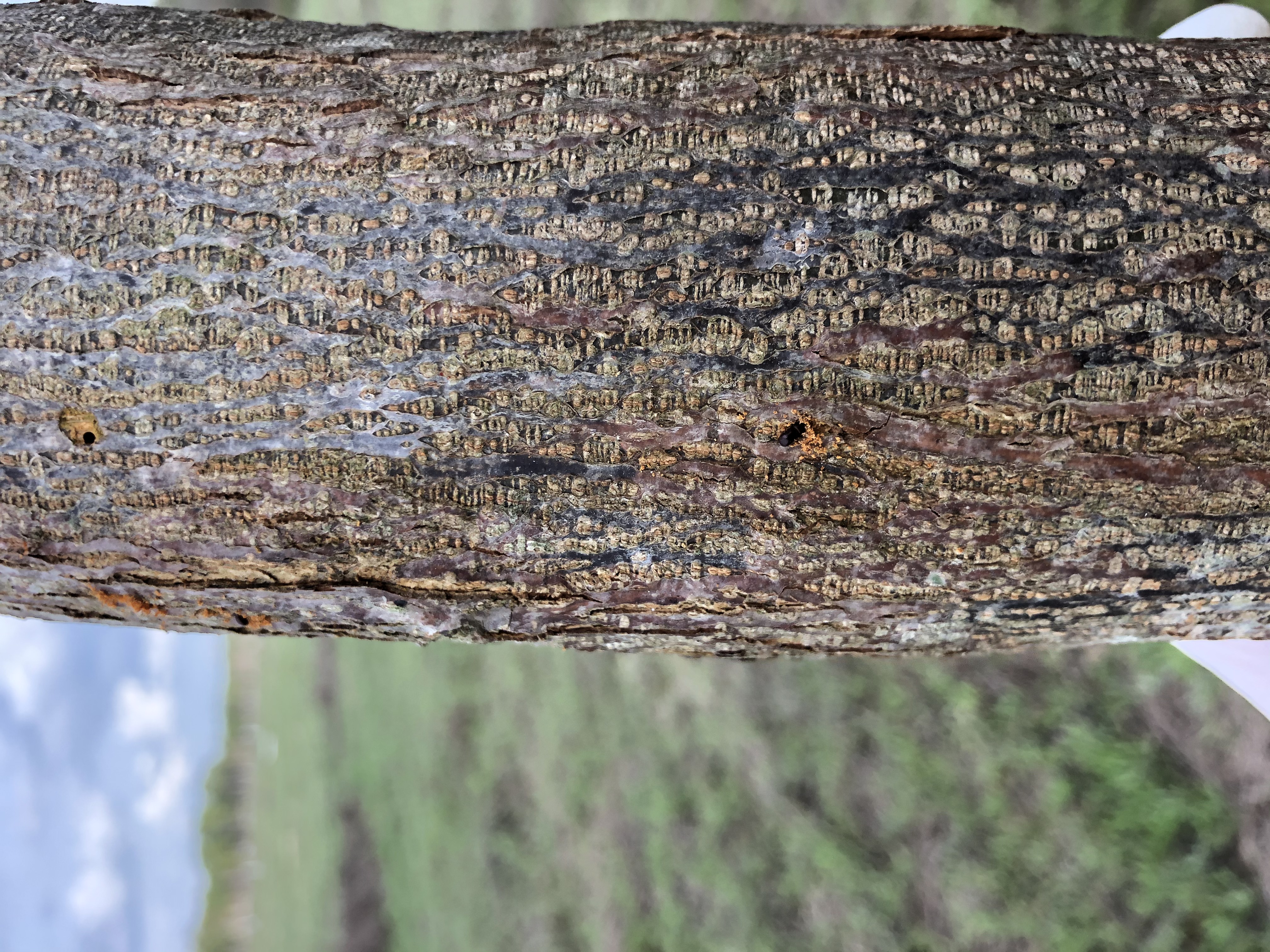
We finally have some data on painting newly planted pecan trees to control Asian Ambrosia Beetle (AAB). With more and more acres of pecan planted in Georgia, this is the most common insect management question. Thanks to our new Entomologist Dr. Angel Acebes-Doria, we now have definitive research from two sites in GA to determine that painting trees alone does not stop AAB from attacking trees. Painting with insecticide sprayed on wet paint was statistically better than painting alone.
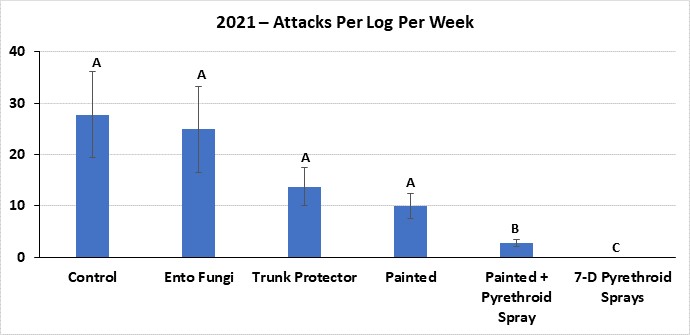
At the Dodge County location, spraying trees every 7 days with a pyrethroid insecticide was the best control. At the Cook County location, paint with insecticide was statistically the same as spraying insecticide. Angel's team conducted this in Cook County, and I performed the research in Dodge County. This is important for pecan growers because it is difficult to spray trees each week. This orchard in my photo is an 800 acre orchard planted in 2019. If painting trees with or without insecticide works, the grower's time is better saved. This work also showed the AAB go into the herbicide guards to attack trees. This means growers must spray down into the herbicide guard if they so choose. This is more labor intensive than using an airblast sprayer since it can only be accomplished with a handheld sprayer.
May 1, 2019 - Southeast Georgia Area Pecan Agent
Andrew joins the UGA Pecan team as the new Area Pecan Agent for Southeast District. This position is from a partnership between University of Georgia Cooperative Extension and the Georgia Pecan Commission. Andrew serves both county agents and growers in Southeast Georgia. His territory stretches from Washington, Jefferson counties north to the Florida line south. It includes everything from the Ocmulgee River to the east coast. Pecan acreage has grown in the southeast for the past 5 - 10 years, and Hurricane Michael's devastation will likely see a shift in pecan varieties in Georgia when replanting new trees.
Andrew previously served as County Extension Coordinator in Wilcox County from 2017-2019 and County Ag Agent in Thomas County from 2011 - 2017. His work in pecans includes Asian Ambrosia Beetles and Pecan Leaf Phylloxera. His programming has focused on young trees, particularly pruning.
Below Andrew is pictured with UGA Pecan Horticulturalist Dr. Lenny Wells:
